01
Paid search built on intent
Search, Shopping and Performance Max split by what the query actually wants, not by product category. Branded gets its own budget so it stops taking credit for demand you already own.

Haris AbbasPaid media and tracking for Google and Meta
Most accounts are not underspending, they are misreading. I rebuild the tracking, then the pages and the campaigns, then the budget follows what actually closes.
Totals across 21 documented accounts, from live Meta Ads data and Google Ads screenshots, converted to US dollars. Screenshots available on request.


A few of the accounts I have run. More logos go up as clients clear them.
Businesses where one new client is worth real money, and where the ad account has to prove it.
Probate, family, personal injury and estate planning. Firms paying for calls and forms that never become signed cases.
Ads for law firmsRoofing, remodelling, HVAC, blinds and moving. High value local jobs where the lead has to be answered before a competitor calls back.
Ads for home servicesInsurance, tax & financial services, where lead quality matters more than lead volume and the report has looked better than the close rate.
Ads for insurance & financeOnline stores & D2C brands on Google Shopping, Performance Max and Meta, judged on revenue and return rather than clicks.
Ads for e-commerceAd spend starts at $5K a month. Within your first month you will see, in your own dashboard, whether that $5K is paying for itself. The whole job is making it pay back, not come out of your pocket.
Not a fit yet: under $3K a month in ad spend, or a sale that closes on a showroom visit nobody can track.
Four things. In this order, because doing them out of order is why most accounts stall.
Search, Shopping and Performance Max split by what the query actually wants, not by product category. Branded gets its own budget so it stops taking credit for demand you already own.
Structures that survive a budget increase. Creative rotated on fatigue signals rather than on a calendar, and spend consolidated so the algorithm gets enough signal to learn.
Server-side GTM, GA4, Meta CAPI, offline conversion imports. Most accounts I open are optimizing toward events that fire twice or fire on the wrong page. Fix that first and the bidding fixes itself.
Product feeds cleaned to the attribute level, landing pages rebuilt around the offer, and the plumbing between a form fill and a booked job.
Real spend, real returns, pulled from live platforms. Open a row for the structure behind the number.
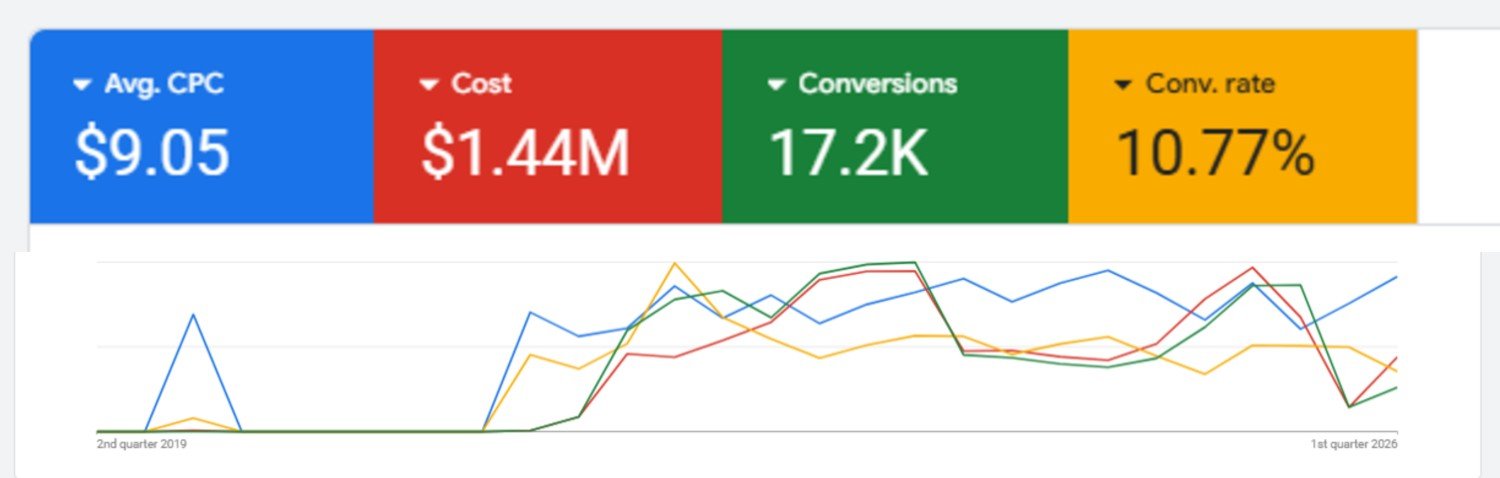
A US probate law firm running roughly $100K a month, built as seven city accounts under one manager account: Houston, Dallas, San Antonio, Austin, El Paso, Corpus Christi and Fort Worth. Restructured to deliver a 65.7% reduction in cost per conversion and a 188% increase in lead volume. The account's all time view reads $1.44M, 17.2K conversions at a 10.77% conversion rate, which is about $84 a conversion. Every call is logged with its city and keyword, so each city's budget answers to its own cost per conversion rather than to a blended average.
THE ACCOUNT, ACROSS TIME


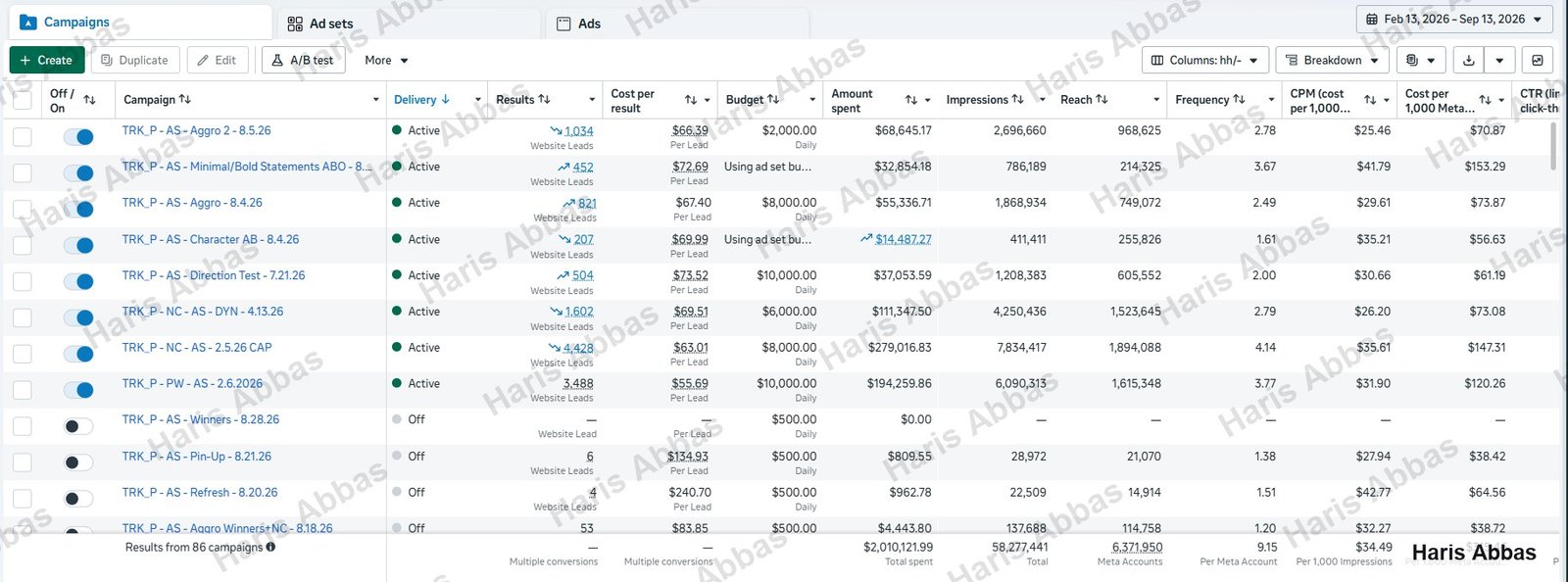
I inherited this account running at about $91,000 a month and took it to $287,000. $2,010,152.62 through it in seven months across 86 campaigns, against 58.3M impressions, 6.37M people reached and 1,125,284 link clicks at $1.79 a click. Tripling what an account absorbs every month usually means the cost per lead runs away from you. Here it moved about $10.

Two equal seven month windows, mine against the one immediately before it. Read the bottom two rows together: the largest campaign produced fifteen times the leads and paid about $10 more for each one. That is what buying three times the volume costs, and it is the trade rather than a caveat.
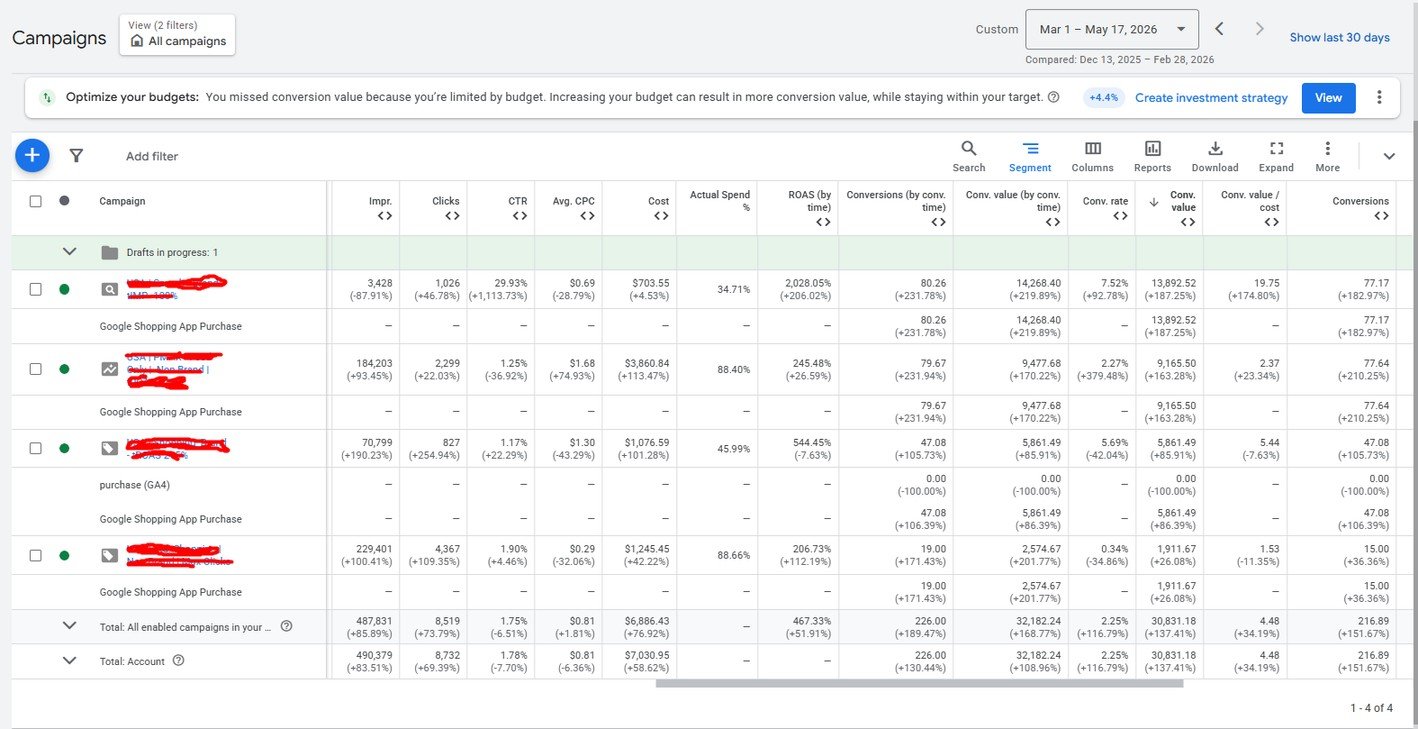
Inherited an underperforming account. Rebuilt the Shopping and Performance Max architecture and refined bidding signals. In 77 days impressions grew 85%, clicks 73%, conversions rose 189%, and conversion value went from roughly $12,986 to $30,831 at 4.48x ROAS on $6,886 in spend.
CTR dipped because I cut the broad match and low intent placements that were buying the clicks. Conversion rate more than doubled on the traffic that was left.
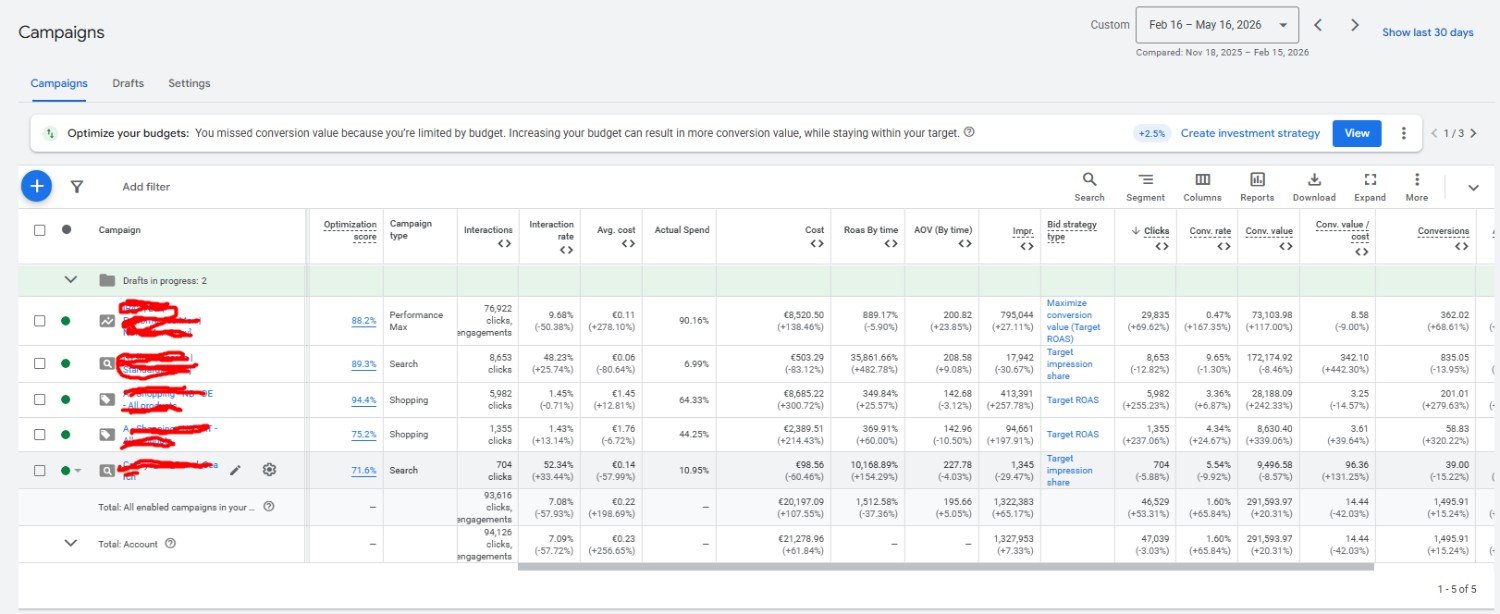
€20,197 in Shopping and Performance Max spend returned €291,593 in conversion value across 46,529 clicks and 1,495 conversions. The strongest ROAS account in the portfolio, built on feed quality and campaign architecture rather than budget.
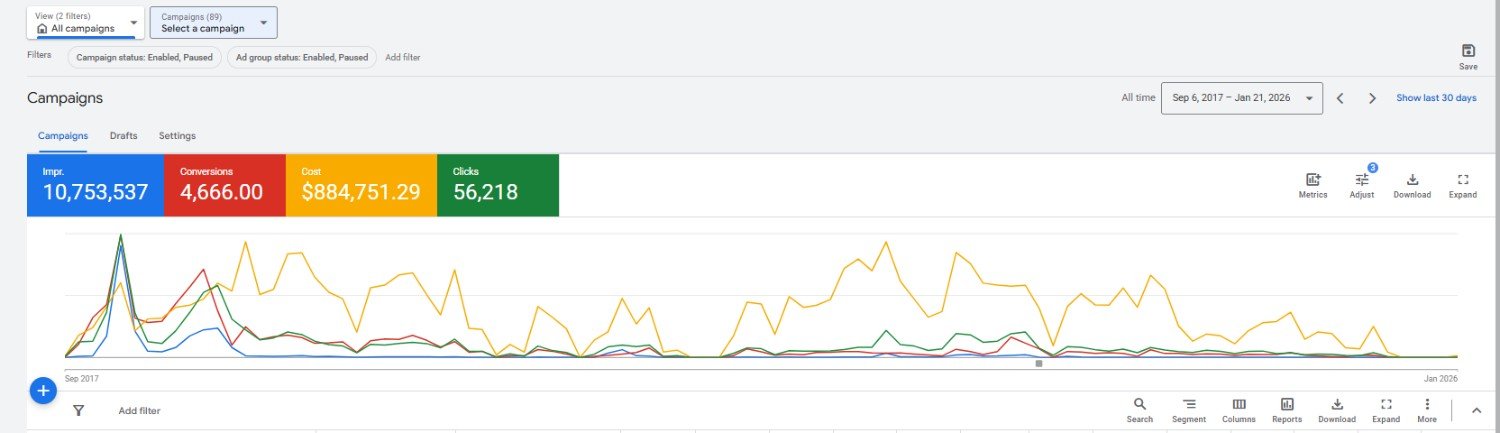
A long-running search account scaled past $884,751 in spend, structured as 63 campaigns split by niche. 10.7M impressions and 56,218 clicks produced 4,666 conversions while holding one strategy over a multi-year period.
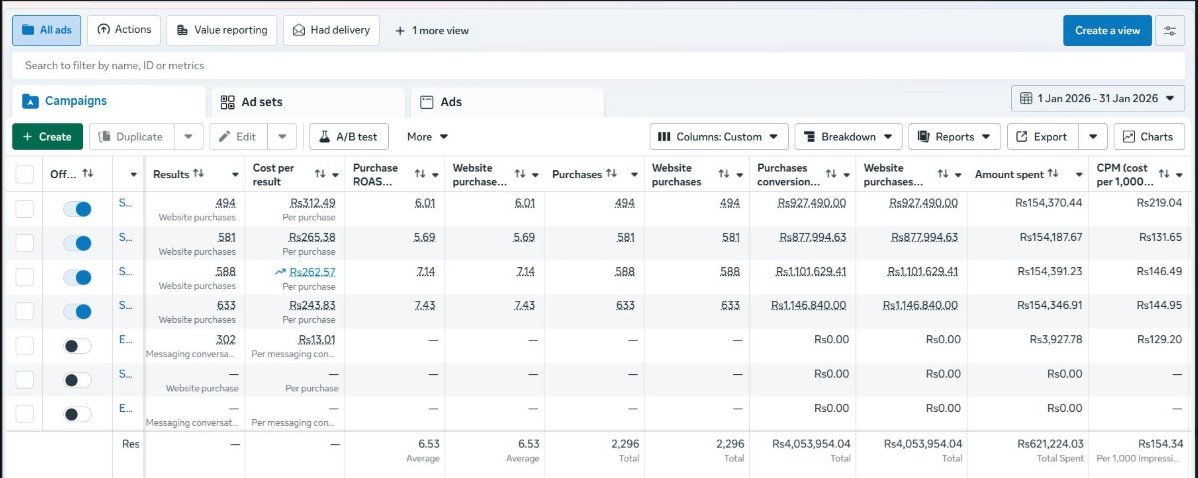
Rs 6.2M in Meta ad spend scaled into Rs 40.5M in revenue and 2,296 website purchases, running multiple CBO campaigns simultaneously without letting blended return slip.

A brand new Meta account for a tax mentorship and academy, no pixel history and no past learnings. Two CBO campaigns, one lead form and one webinar funnel, produced 118 form leads in 12 days on $357.50 in spend at $3.03 per lead. 13 of those leads have converted so far.
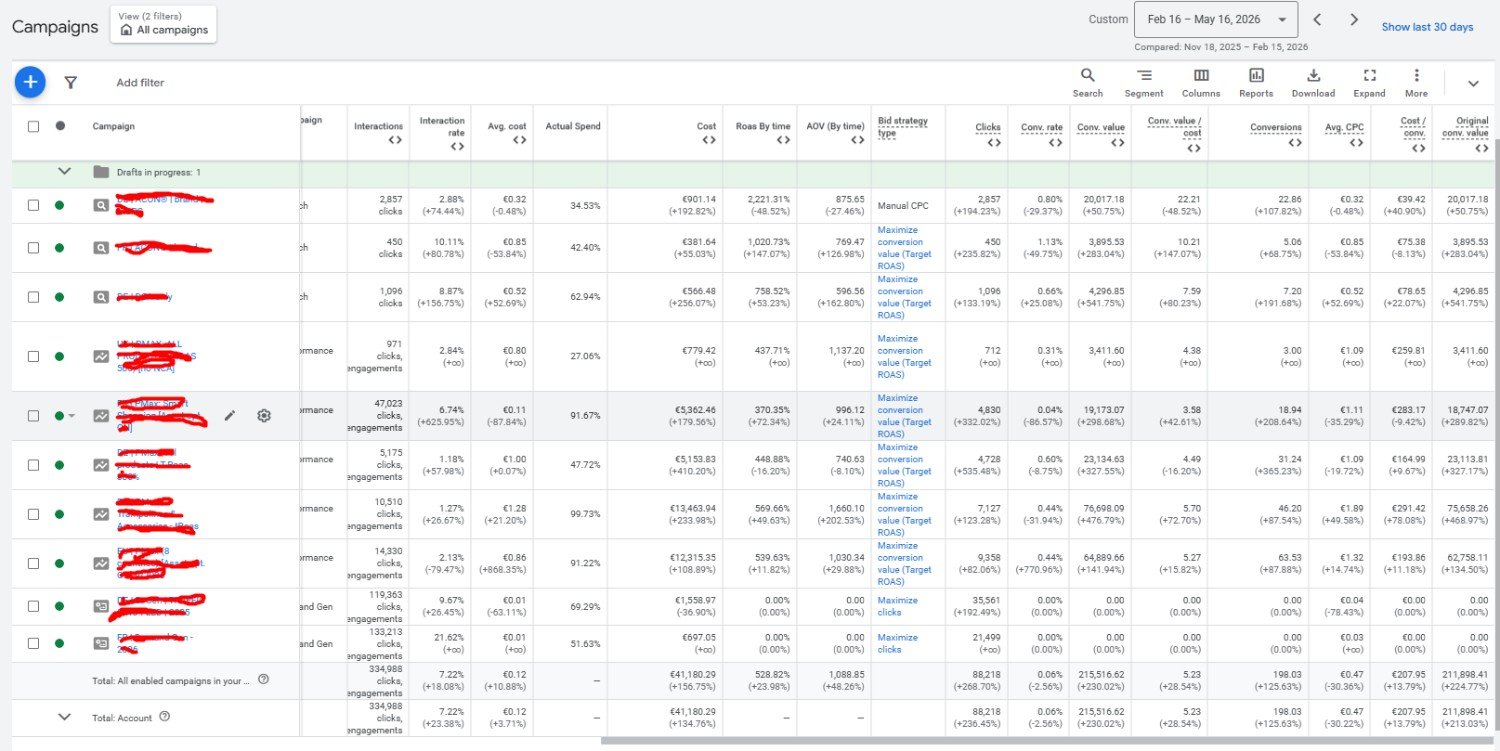
€41,180 in Shopping budget scaled into €211,898 in conversion value across 88,218 clicks, structured across Shopping and Performance Max with separate bidding strategies per intent tier.
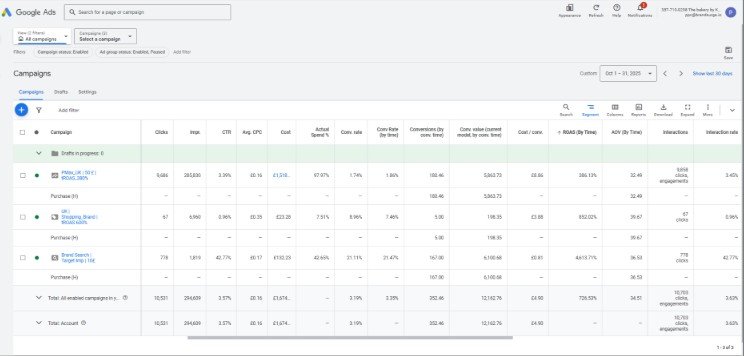
Unified Meta and Google into one acquisition system. £1,574 in Google spend returned £12,142 at £4.90 CPA across 250+ conversions, while Meta returned $9,977 on $3,581 at 2.79x.
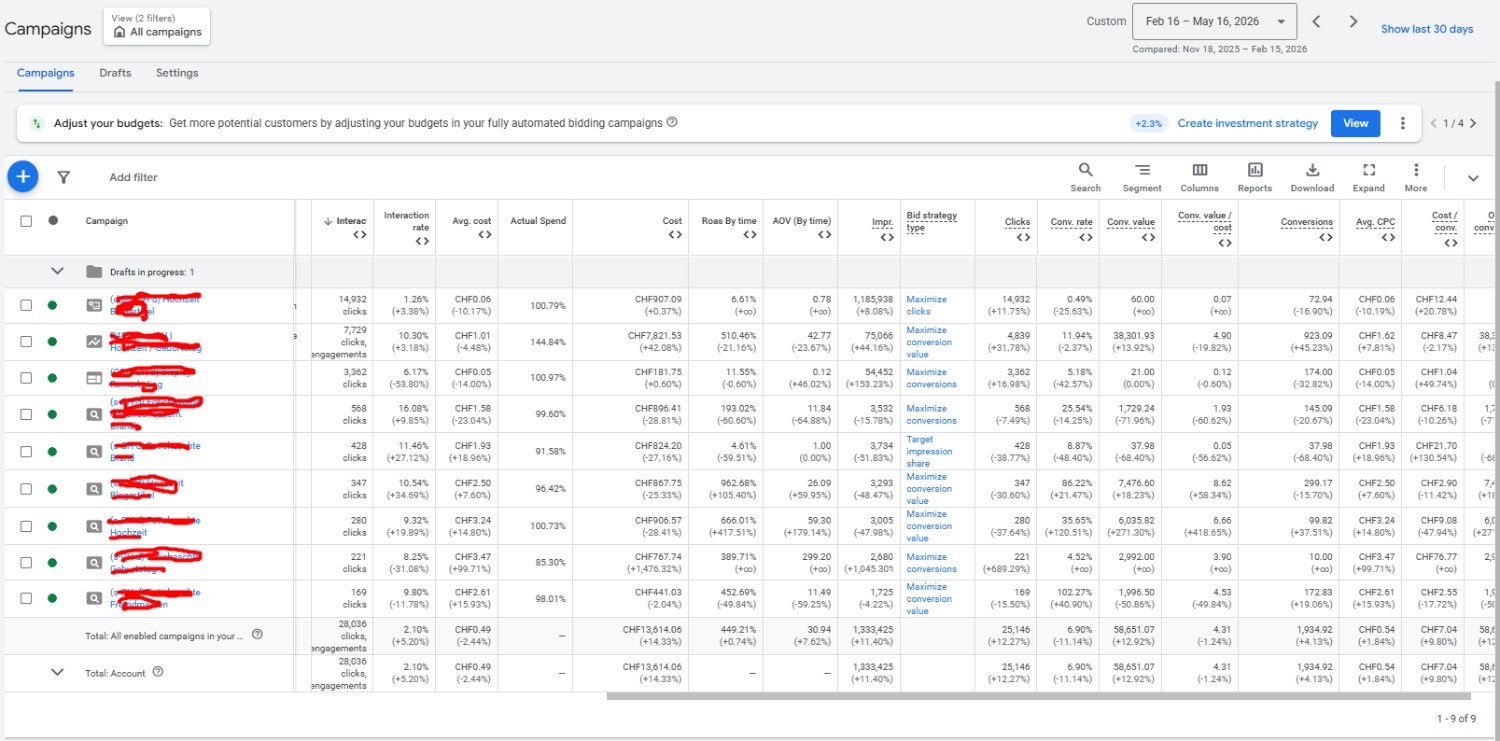
CHF13,614 in spend generated CHF58,651 in revenue with 1,934 conversions at CHF7.04 per conversion, one of the lowest CPAs across all managed accounts.
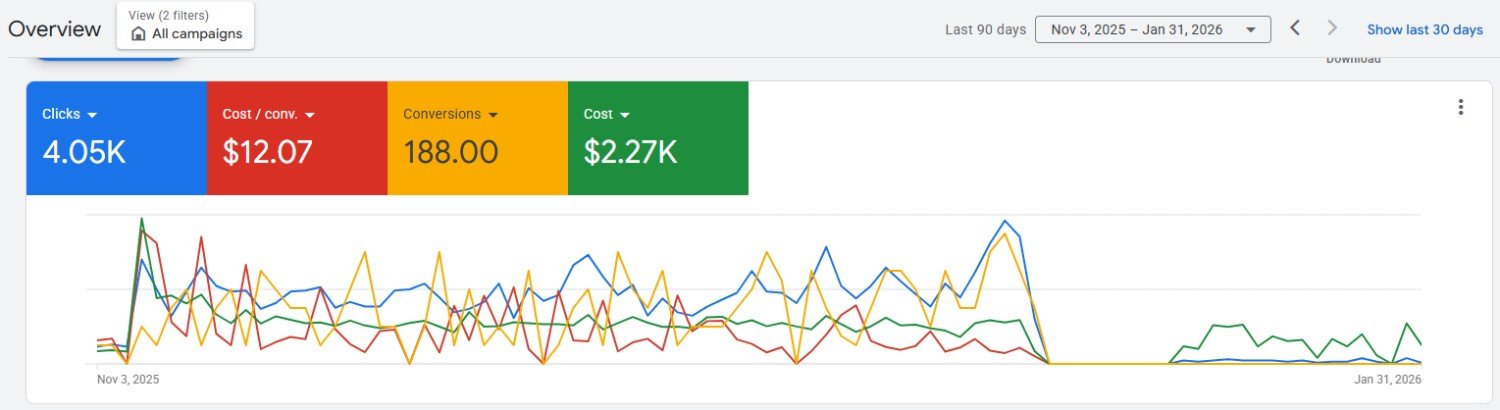
A $2.27K Google Search budget produced 188 qualified patient leads at $12.07 per acquisition, with a 5.39% CTR driven by tight ad-to-landing-page relevance.
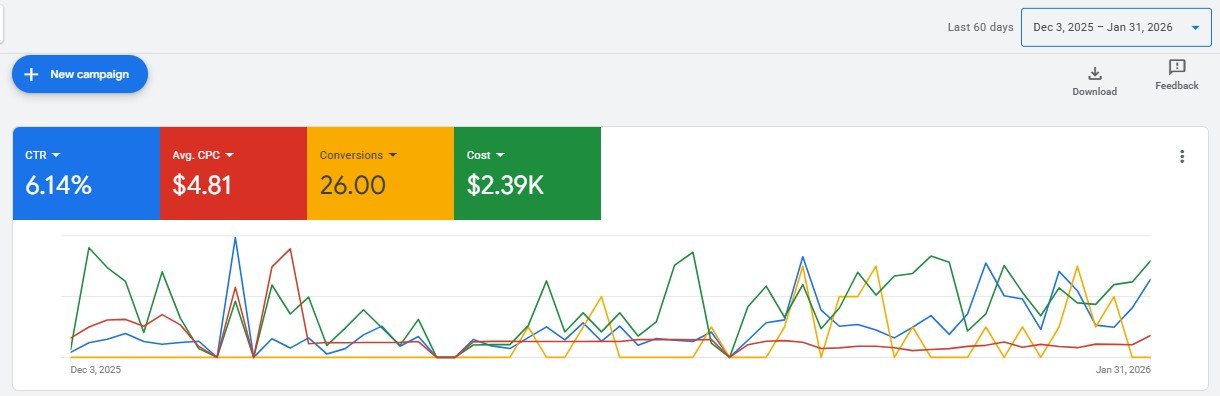
Segmented generic product searches from branded terms for a corporate merchandise distributor, turning $2,392 in spend into 26 high-value quote requests and inbound calls. Branded traffic ran at a 23.91% CTR against 6.14% account-wide.
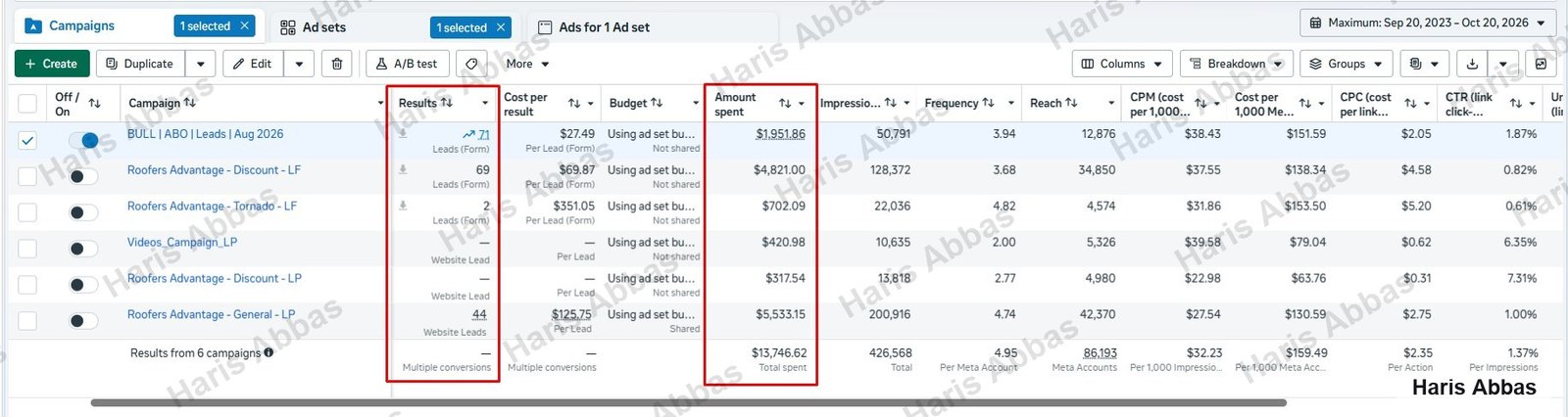
Took over a roofing contractor's Meta account from a previous agency in August 2026. Their best campaign, on lead forms, had produced 69 leads at $69.87 each, and their landing page campaign 44 at $125.75. Rebuilt as one campaign on instant forms with new creative, the same account produced 71 leads at $27.49 each by 20 October, on $1,951.86.
The previous agency's best campaign against mine, in the same ad account. The two ran for different lengths of time, so read the cost per lead, not the totals: about 40% of the spend bought slightly more leads.
Two days inside the account: structure, search terms, conversions and tags. I come back with what is broken, what it costs a month and what I fix first.
Before any budget moves: server-side tagging, deduplicated events and a value on every conversion, so the platform learns from real revenue.
Campaigns rebuilt by intent and margin, pages and forms rebuilt around the offer. Traffic is worth what the page converts, so CRO starts right here.
Controlled spend, clean signal and a learning window nobody panics through. No bid changes for two weeks. That patience is most of the result.
Weekly search term and placement hygiene, creative rotation, budget moved toward what closes, not what converts. This is where 4x becomes 15x.
The unglamorous list. What lands in your inbox, how often, and what you walk away with if it ends.
He rebuilt the account in two weeks and cost per lead dropped by more than half.
Shopping had been flat for a year. He restructured the feed and conversions went up 189% in 77 days.
First Meta account we ever ran. 118 leads in twelve days and thirteen already paid.
Our tracking was wrong for two years. He found it on the audit call and fixed it in two days.
Thirty minutes, inside your account, with you watching. No pitch deck and nothing to sign. Here is what happens after you book.
The questions that come up on every first call. If yours is not here, the form below reaches me directly.
Management is a flat monthly fee, set against the size and messiness of the account rather than a percentage of spend. A percentage rewards me for spending more of your money, which is the wrong incentive to put in a contract. Most accounts land between the price of a junior hire and a fraction of one. You get the number on the first call, in writing, before anything starts.
Tracking and structure work lands in the first two weeks, and that alone usually moves reported numbers because they were wrong before. Real performance change shows in weeks three to six, once the bidding has enough clean signal to learn from. Anyone promising a turnaround in seven days is either sitting on an account that was badly broken or about to spend your budget proving a point.
Admin access to the ad accounts, analytics and tag manager, someone who can approve a landing page change, and honest numbers on margin and close rate. That last one matters more than it sounds: without it I am optimising toward conversions instead of profit, which is how accounts end up looking healthy and losing money.
No. Rolling monthly, thirty days notice either way. The account, the data and the work stay yours if you leave.
It is the normal starting point. Most accounts I open are optimising toward events that fire twice, fire on the wrong page, or fire on a thank you page nobody reaches. A messy account with real spend history is usually easier to fix than a clean one with no data at all.
Around $3K a month in media is the floor, and most clients start at $5K. Below $3K there is not enough data for the bidding to learn from, and you are better off putting the money into the offer and the landing page until there is.
The portfolio runs across legal, healthcare, e-commerce, education and B2B, in the US, UK and EU. What carries across is the mechanics: intent, tracking, margin and structure. If it is a vertical I genuinely cannot help with, I will say so on the first call rather than learn on your budget.